Skip to main content



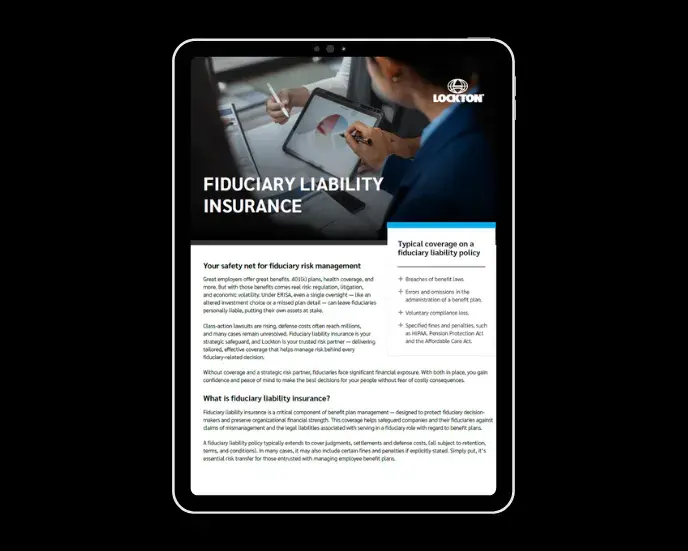

Protect executives and fiduciaries from financial, governance, and cyber‑related liability. Expert fiduciary liability insurance solutions for complex risk'
Your safety net for fiduciary risk management
Great employers offer great benefits. 401(k) plans, health coverage, and more. But with those benefits comes real risk: regulation, litigation, and economic volatility. Under ERISA, even a single oversight — like an altered investment choice or a missed plan detail — can leave fiduciaries personally liable, putting their own assets at stake. Class-action lawsuits are rising, defense costs often reach millions, and many cases remain unresolved. Fiduciary liability insurance is your strategic safeguard, and Lockton is your trusted risk partner — delivering tailored coverage that helps address risk behind every fiduciary-related decision. Without coverage and a strategic risk partner, fiduciaries face significant financial exposure. With both in place, you gain confidence and peace of mind to make the best decisions for your people without fear of costly consequences.
What is fiduciary liability insurance?
Fiduciary liability insurance is a critical component of benefit plan management — designed to protect fiduciary decision-makers and preserve organizational financial strength. This coverage helps safeguard companies and their fiduciaries against claims of mismanagement and the legal liabilities associated with serving in a fiduciary role with regard to benefit plans. A fiduciary liability policy typically extends to cover judgments, settlements and defense costs, (all subject to retention, terms, and conditions). In many cases, it may also include certain fines and penalties if explicitly stated. Simply put, it’s essential risk transfer for those entrusted with managing employee benefit plans.
Typical coverage on a fiduciary liability policy
Breaches of benefit laws.
Errors and omissions in the administration of a benefit plan.
Voluntary compliance loss.
Specified fines and penalties, such as HIPAA, Pension Protection Act and the Affordable Care Act.
Claims management
Claim performance is the true measure of any fiduciary liability insurance program. Lockton’s Professional & Executive Risk Claims team is purposely structured to help you maximize your fiduciary liability insurance recoveries. Lockton does not silo claims, nor do we treat claims advocacy services as a profit center. Instead, we integrate experienced insurance and claims counsel within your broking team. This ensures that claims strategy and advocacy begin at the very start of our partnership with you, so when a fiduciary liability insurance claim does arise, we’re fully prepared.
Download our flyer
Learn how we help protect your business from fiduciary-related risk by downloading our fiduciary liability insurance flyer.
Download NowOur latest news and insights

Fiduciary liability insurance FAQs
Who can be covered under a fiduciary liability policy?
Coverage under a fiduciary liability policy typically extends beyond just the organization, it includes the individuals and entities involved in managing benefit plans. Those commonly covered are:
The organization/company
Benefit plans
Employees
Subsidiaries (as defined in the policy)
Spouses and domestic partners
Estates and heirs
Past employees retained as fiduciaries or consultants
Committees and their members
Trustees
What is a fiduciary?
Outside of insurance, a fiduciary is generally defined as someone entrusted to manage money or property for another party, such as a trustee. In the context of fiduciary liability insurance, a fiduciary is any individual who:
Exercises discretionary authority or control over the management of a benefit plan.
Holds discretionary responsibility in the administration of the plan.
Provides investment advice for a direct or indirect fee regarding plan assets.
Exercises authority or control over the management or disposition of plan assets.
Simply put, fiduciaries are decision-makers with a legal duty to act in the best interest of plan participants.
Why do you need fiduciary liability insurance?
If you sponsor any type of employee benefit plan, you assume legal liability – and that makes you a potential target for lawsuits. Many organizations believe hiring outside professionals eliminates fiduciary risk. It doesn’t. While outsourcing is a smart way to reduce exposure, ultimate responsibility remains with the employer. You are still accountable for the actions of the firms you select and must monitor their performance. Fiduciary liability insurance provides essential protection against these risks, covering defense costs, settlements, and judgments that could otherwise threaten your financial stability.
How does fiduciary liability insurance complement similar lines of coverage.
Fiduciary liability insurance is designed to address allegations of breaches of fiduciary duties under benefit laws such as ERISA. Most policies also include employee benefits liability (EBL) coverage, which protects against administrative errors in plan management. While EBL is often added to a general liability (GL) policy, fiduciary liability goes further. It covers governance and decision-making risks. It is also distinct from an ERISA bond, which insures plan assets against theft and is typically provided under a crime/fidelity policy. An ERISA bond is legally required; fiduciary liability insurance is not, but it is essential for comprehensive protection.