
Workforces are changing faster than most organisations can adapt. For employees, expectations surrounding benefits, fairness, flexibility, and communication have risen.
We have identified six interconnected pillars that define successful employer propositions in the modern workplace. This article focuses specifically on two critical pillars: 1) benefits, recognition, and rewards programmes, and 2) communication delivery. We explore how organisations can evolve beyond traditional benefits offerings and reactive communication approaches that are no longer hitting the mark.
The strategic problem: fragmentation, low perceived value, and delivery challenges
Despite increased investment, many employers experience static engagement levels and a decline in perceived value from their spend, consequently:
Benefits often expand without clear strategy or alignment to employee actual needs.
Recognition practices vary widely and lack consistency.
Reward systems struggle to meet rising expectations and transparency concerns.
Communication is episodic and heavily dependent on overstretched HR teams.
At the same time, provider ecosystems continue to grow, increasing operational, people, and data risk. When these elements are managed in isolation, the overall employer proposition weakens.
Benefits, reward, and recognition
Benefits – relevance, alignment, risk, and the need for coherent design
Benefits as a collective have tremendous, and often untapped, potential to align with both individual needs and organisational strategy and brand. To be a real engagement lever and differentiator, benefits should reflect demographic needs, reinforce culture, and deliver demonstrable value. However, amidst rising cost exposure, employers may often duplicate spend with overlapping providers or benefits. Programmes should be evaluated for relevance, cultural alignment, value for money, usage, and provider quality to counter duplication, low-value offerings, and benefits that no longer suit workforce or business needs.
The expansion of wellbeing vendors has increased capital and operational and data risk, while HR bandwidth constraints can make it difficult to maintain or augment these offerings. A clear structure is needed to assess the ecosystem, clarify priorities, and shape a more coherent, manageable, and easier-to-communicate benefits offering.
Recognition – clarity, fairness, and alignment with the employer story
Recognition is often the most immediate expression of culture. When unclear or inconsistently applied, it undermines trust in both reward and leadership. Many organisations rely on informal or manager-dependent systems that do not scale across hybrid or distributed teams. Employers need clarity on what they intend to recognise, how recognition should be delivered (through a variety of tools and practices available), and how it supports engagement and expected behaviours and performance. This strengthens and promotes recognition as a clear, fair, continuous, and aligned component of the employer narrative.
Reward – structure, progression, and transparency readiness
Increasingly, reward is being viewed as a system, rather than a pay decision. Employees evaluate salary, benefits, development access, progression, and fairness as a singular interconnected experience. Many organisations lack the structure and data readiness to meet rising transparency expectations or regulatory requirements.
Businesses require a framework to review reward architecture, progression pathways, total reward visibility, and data quality. This helps identify gaps where decisions cannot be explained – or defended – and ensures reward is aligned with workforce needs and transparency obligations.
Communication and delivery
Communication is a critical component of your benefits and reward strategy, and all other elements of the EVP. Even the best-designed programme will fall short if employees do not understand it, know how to use it, or recognise its relevance to them. Effective communication requires simple, clear, and consistent messaging that cuts through complexity and taps into emotions. Employees, often overwhelmed by dense or technical information, will struggle to make sense of what is available if communication is limited to sporadic announcements. Benefits need to be communicated in a way that is accessible and meaningful, with clear explanation on why the benefit exists, how it helps them, and where they can access them.
Delivery needs to happen across multiple channels and in multiple formats, while being dynamic enough to recognise how employees access and consume content. A single announcement will not drive understanding or behaviour change. Instead, organisations should use planned campaigns, event-driven updates, and timely reminders. Communication should also be structured around key life and work events, such as onboarding, parental leave, financial decision points, or changes in personal circumstances – helping employees to engage with benefits when they are most relevant.
Managers play a key role in reinforcing messages. However, to deliver this confidently, leaders should be equipped with clear key messages, a straightforward narrative to follow, and a defined path for any questions they cannot answer. Leadership visibility also matters, as consistent endorsement from senior figures signals organisational commitment. Typically, many employees prefer to navigate information independently. Therefore, communication should be supported by an intuitive digital experience. Microsites, short guides, mobile-friendly content, and clear signposting reduce friction and increase uptake.
Measurement is essential to understand what works and where improvements are needed. Tracking usage, engagement patterns, search queries, and employee questions provides insight into gaps and helps refine campaigns. Without these insights, communication remains reactive rather than strategic. Ultimately, communication and delivery are what determine whether benefits, rewards, and recognition achieve their intended outcomes (and indeed the wider EVP). Without a clear system that explains, simplifies, and reinforces the offering, employees are unlikely to see or feel the value – regardless of investment.
Prosper: the solution architecture
Lockton Prosper is a solution to these challenges for employers to design and deliver engaging and sustainable offerings that align with the organisation’s current and future workforce strategy.
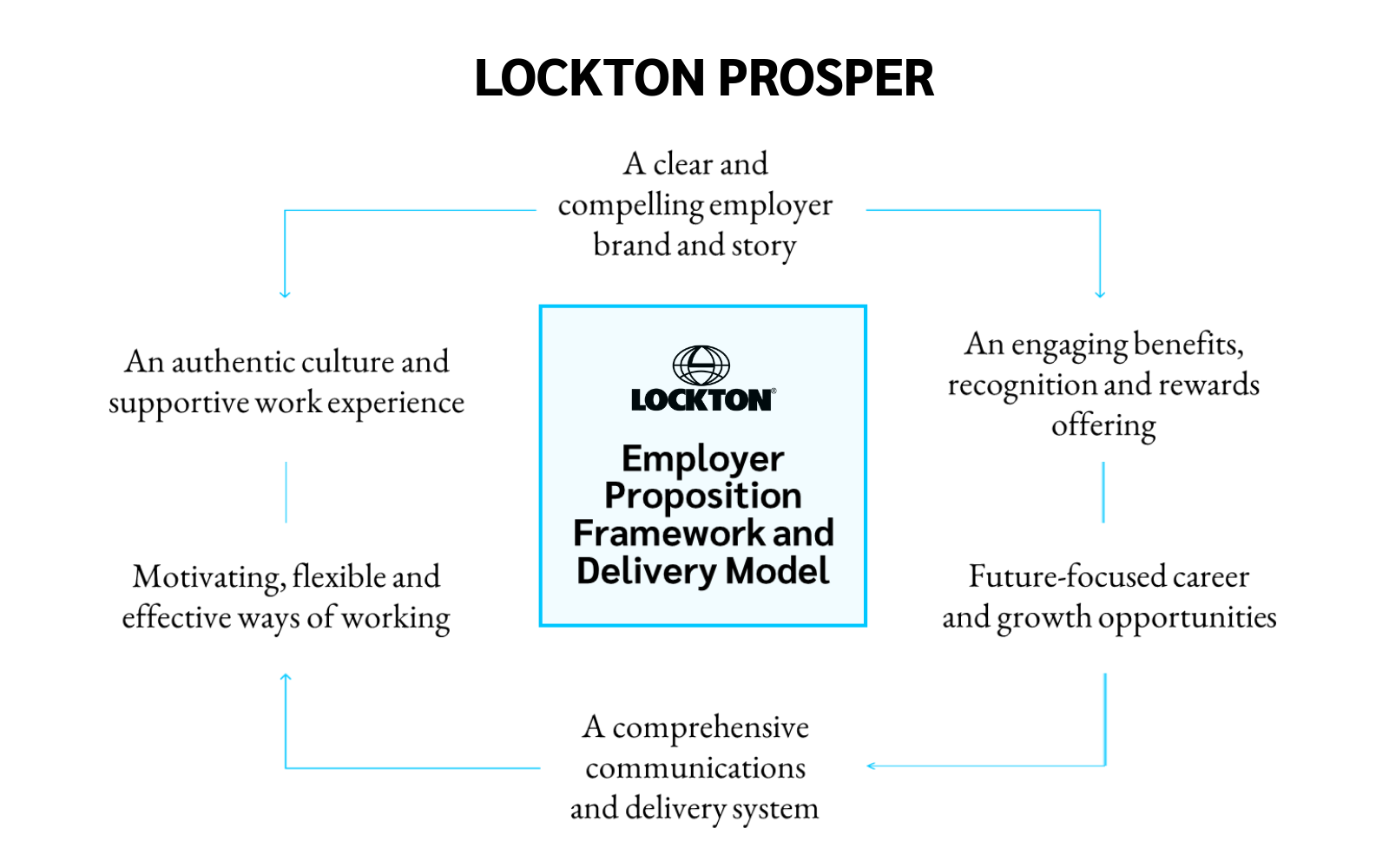
Prosper helps employers understand and address the factors that limit the effectiveness of their benefits, reward, and recognition programmes. It provides a connected framework that diagnoses gaps, prioritises investment, strengthens governance, and establishes the communication infrastructure needed for effective delivery. Prosper brings benefit design, recognition practices, reward structures, and communication together into a single, coherent employer proposition; linking with the other critical elements of the wider proposition.
Capturing the patterns of success we see in organisations that attract and retain talent over the long term, Lockton Prosper translates these into practical tools leaders can use to design, test, and deliver an employer proposition that works in real life. The goal is straightforward: a proposition grounded in clarity and evidence, reinforced through culture, and capable of adapting as workforce expectations continue to shift.
If you are ready to assess how your proposition stands up, start the conversation with us today by visiting our dedicated Prosper page here (opens a new window).
In the final article of our Prosper series, we will examine the final components of the framework, exploring how organisations are reshaping career development for a multi-generational workforce and implementing flexible work models that support performance – both now and in the future. To read our first article, which introduced the Prosper model itself and examined two of its pillars: focusing on culture, employer story and the clarity of organisational messaging, click here (opens a new window).