
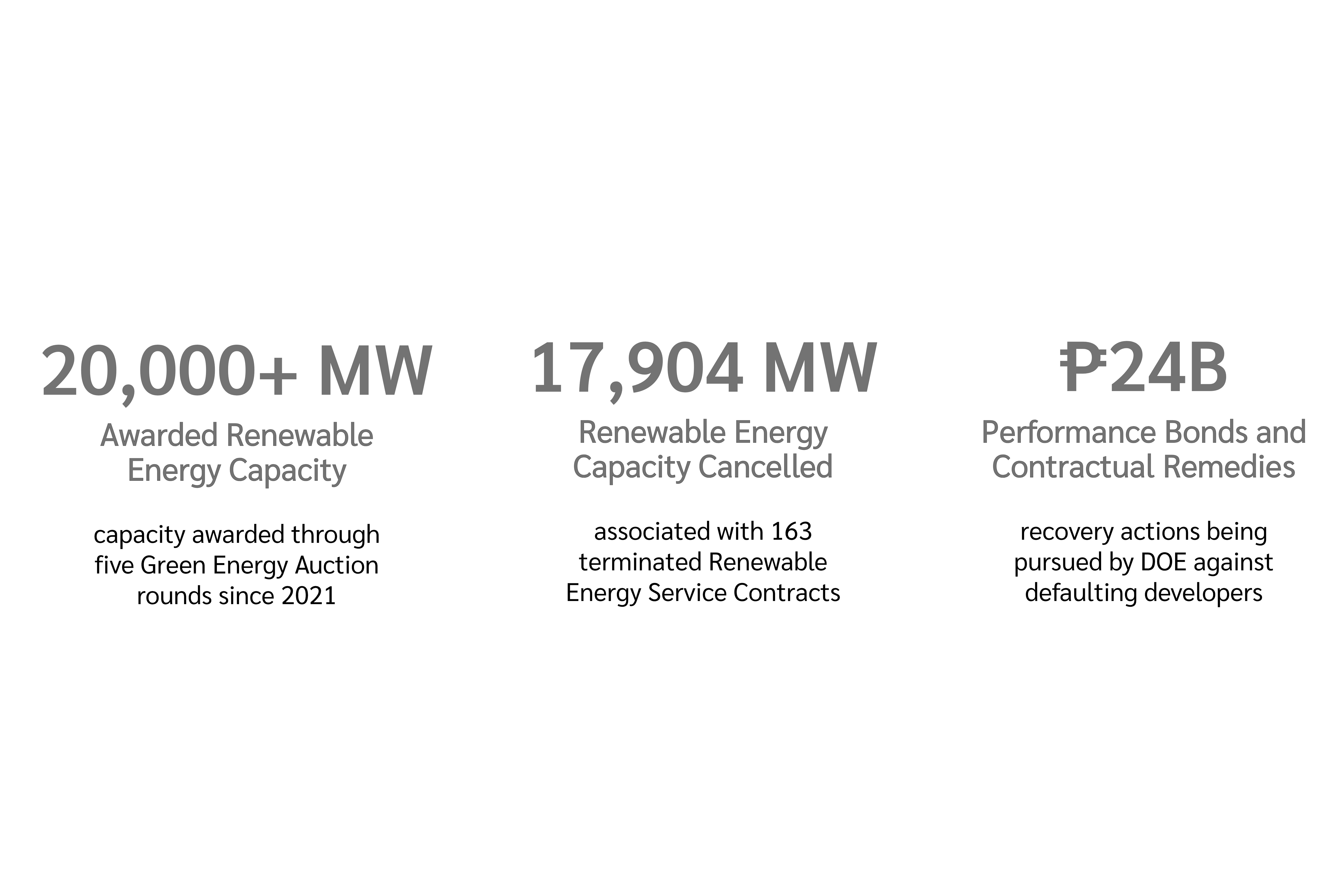
Since the launch of the Green Energy Auction (GEA) Program in 2021, the Department of Energy (DOE) has awarded more than 20,000 MW of renewable energy capacity across five auction rounds. These awards reflect the government's continued commitment to accelerating renewable energy deployment through competitive procurement.
At the same time, the Department has strengthened enforcement against non-performing developers. Between 2024 and 2025, the DOE terminated 163 Renewable Energy Service Contracts (RESCs) representing 17,904.02 MW of potential renewable energy capacity after project proponents failed to meet contractual milestones. The Department also announced that it would pursue the collection of performance bonds and other contractual remedies, estimated at approximately ₱24 billion for affected projects, together with civil, administrative, and criminal actions where warranted.
These developments point to a broader reality. Awarding renewable energy capacity is only the beginning. Converting awarded projects into operating generation has become the more difficult challenge.
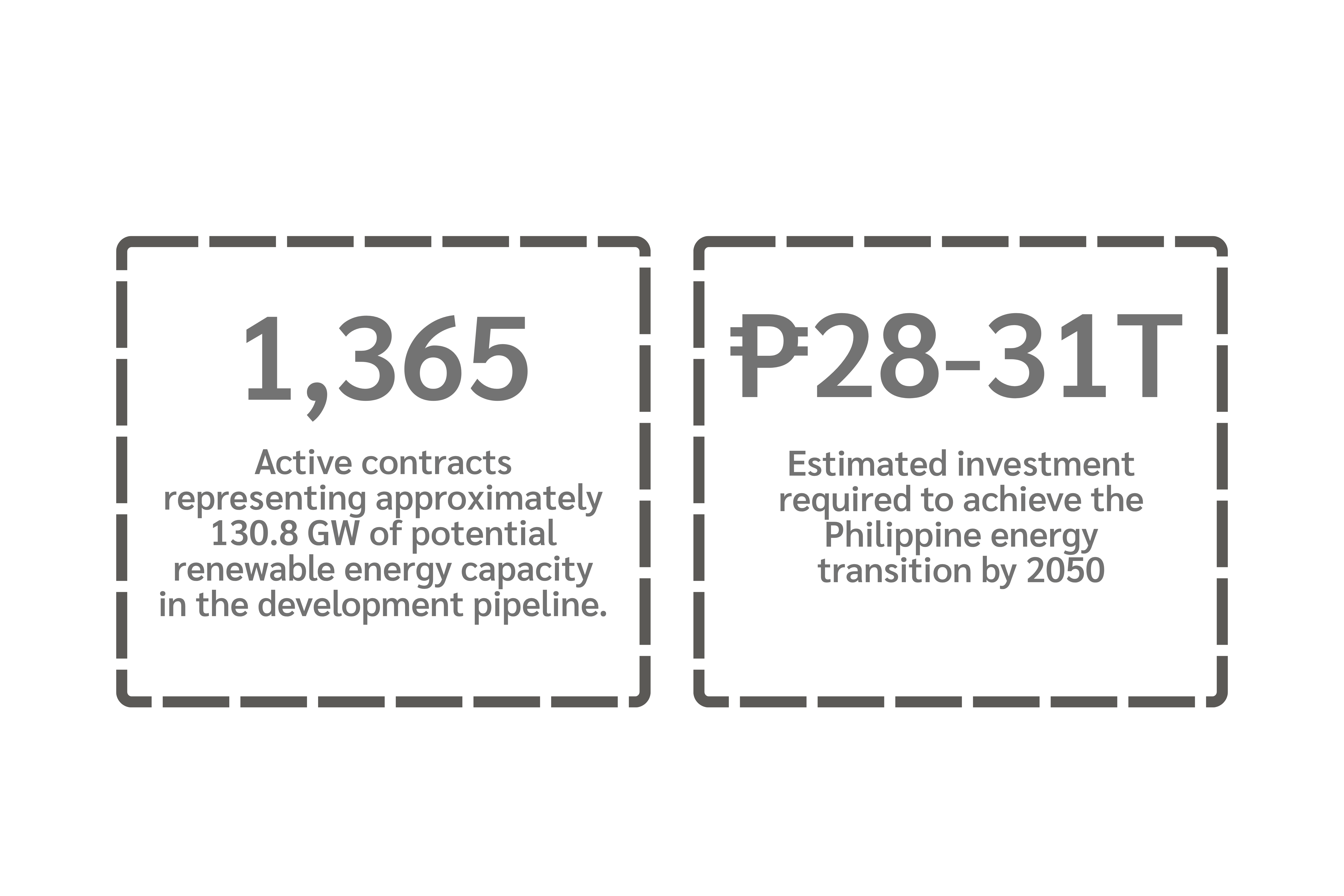
The DOE estimates that achieving the country's energy transition objectives will require between ₱28 trillion and ₱31 trillion in investments through 2050. As of December 2025, the Department reported 1,365 active Renewable Energy Service Contracts representing approximately 130.8 GW of potential capacity. BloombergNEF also continues to rank the Philippines among the world's most attractive emerging renewable energy markets.
The challenge is no longer building a pipeline of renewable energy projects. It is moving those projects through the grid and into commercial operation.
DOE has consistently identified transmission planning and grid readiness as prerequisites for renewable energy integration. Through its Competitive Renewable Energy Zones (CREZ) framework, the Department has emphasized that renewable energy development and transmission expansion must progress together so new generation can be absorbed by the power system.
It has publicly raised concerns over delays in several major transmission projects under the National Grid Corporation of the Philippines' Transmission Development Plan, including the Cebu–Negros–Panay backbone. Separately, the Philippine News Agency has reported that transmission limitations continue to restrict the evacuation of new renewable generation in several island grids where renewable capacity has expanded faster than supporting transmission infrastructure.
Grid access itself introduces another layer of uncertainty.
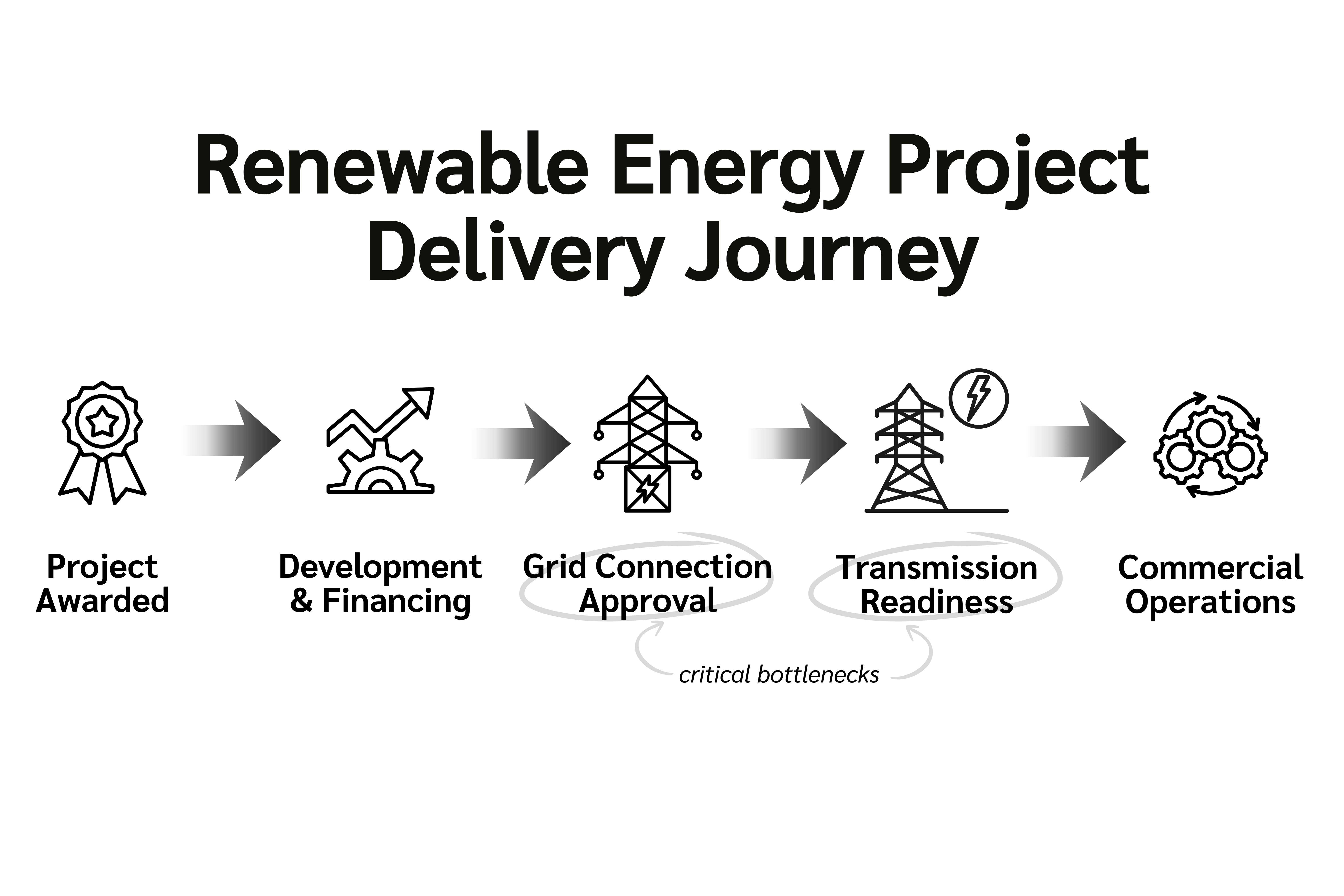
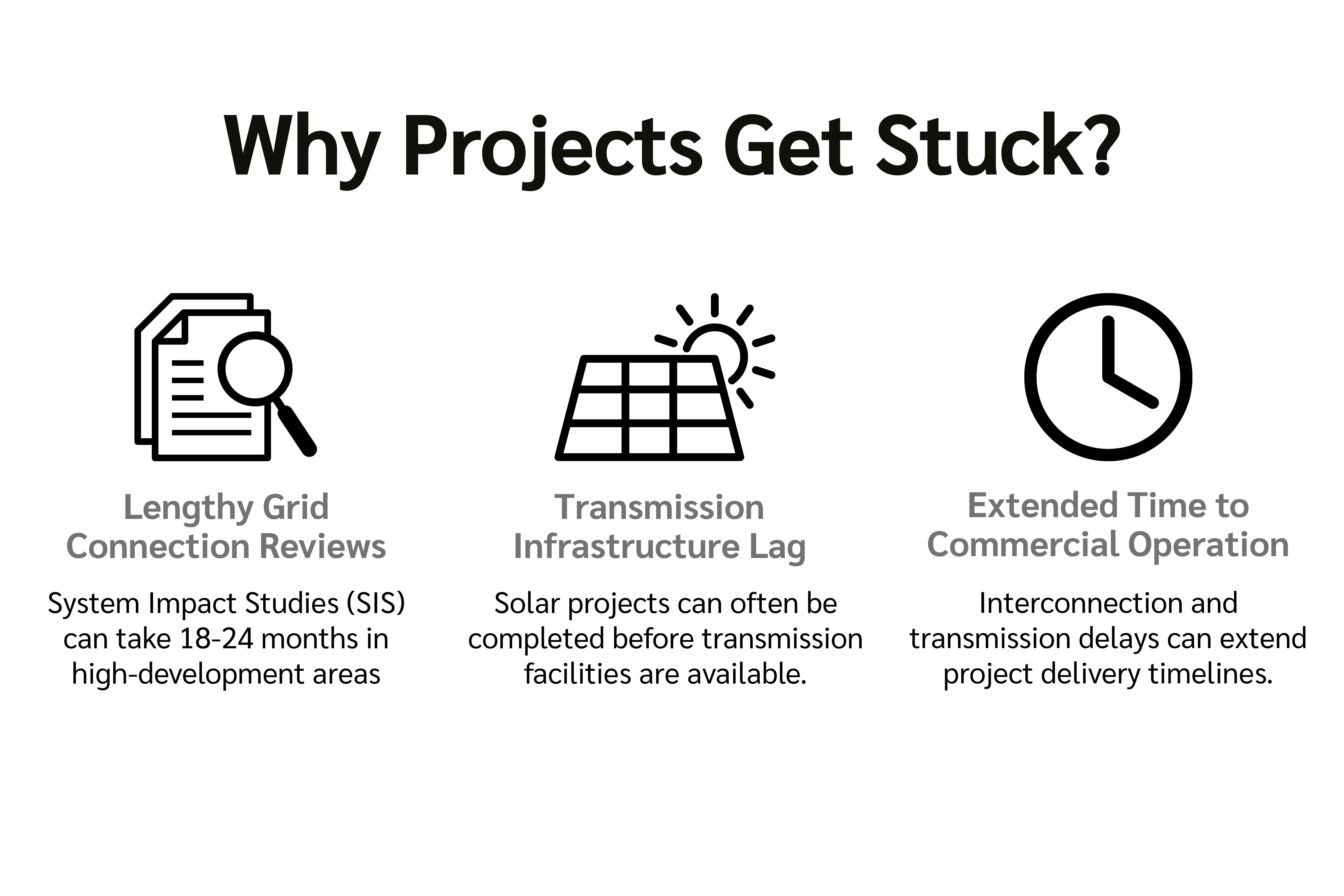
Before a generating facility can connect to the transmission network, it must complete a System Impact Study (SIS) administered by the National Grid Corporation of the Philippines (NGCP) or the relevant transmission provider. DOE officials have noted that these studies may require approximately 18 to 24 months in areas experiencing significant renewable energy development. During that period, project development continues while the timing and conditions of grid connection remain under evaluation.
Industry experience increasingly points in the same direction.
Following the first Green Energy Auction, renewable energy developers noted that while utility-scale solar facilities can generally be constructed within six to twelve months, overall project delivery in the Philippines frequently stretches to two or even three years because transmission and interconnection requirements take considerably longer to complete.
The same pattern has been observed internationally. In its review of Brazil's renewable energy auctions, the International Renewable Energy Agency (IRENA) concluded that delays in transmission expansion and poor coordination between generation and grid development became major causes of implementation delays, despite strong investor participation and competitive auction outcomes.
The experience across markets points toward the same conclusion. Renewable energy projects are increasingly constrained not by construction capability, but by how closely project development is synchronized with transmission readiness.
This has important implications once projects approach financial close.
Developers progressively commit to engineering, procurement and construction (EPC) contracts, equipment procurement, financing arrangements, technology selection, and project schedules. Each commitment becomes increasingly difficult to reverse. Yet key assumptions—including transmission availability, interconnection timing, and commissioning schedules—may still be evolving.
Transmission uncertainty therefore extends beyond engineering.
It begins to influence project economics.
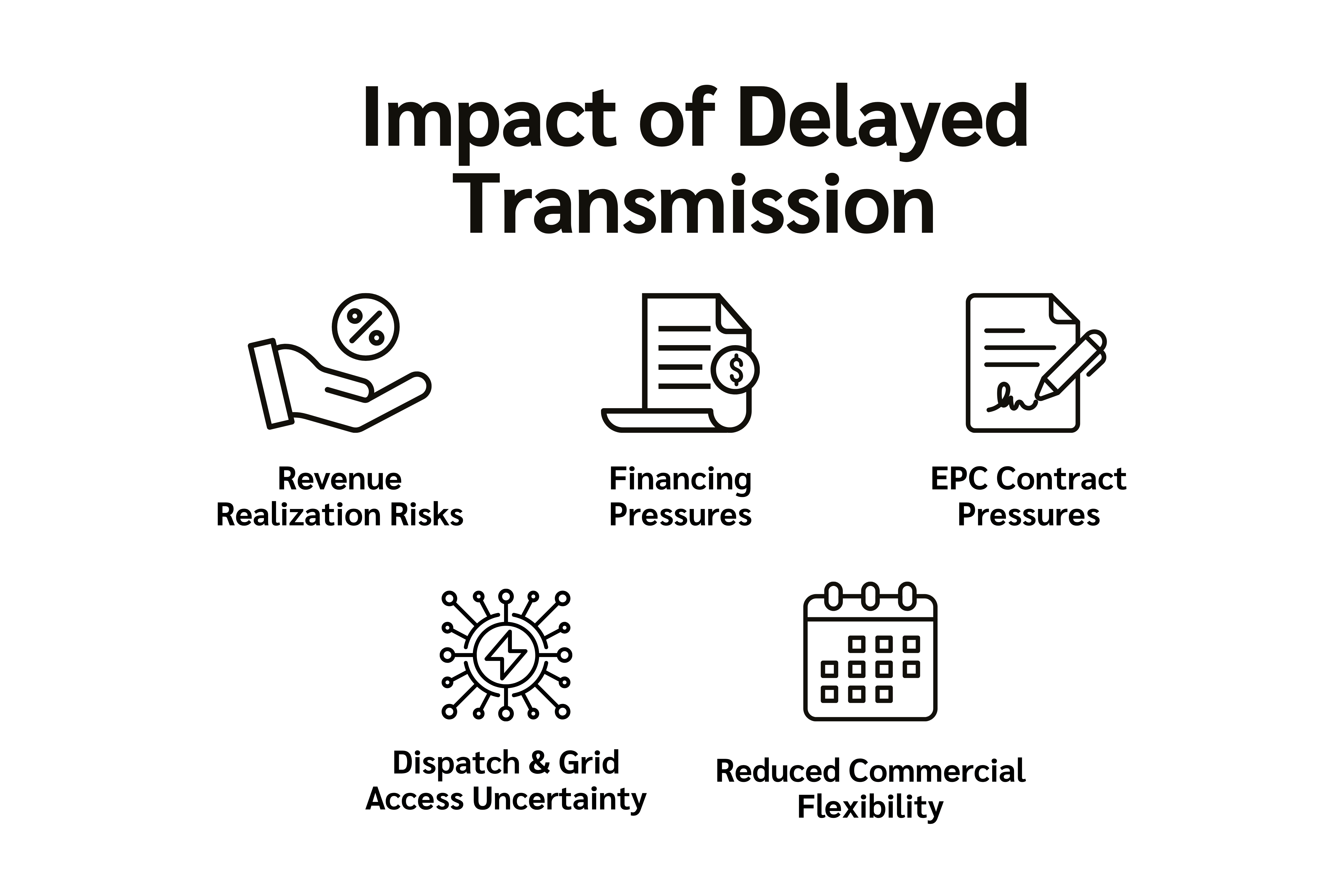
Commercial arrangements differ across renewable energy projects. Some generators operate under contracted capacity arrangements, while others deliver electricity under Renewable Energy Payment Agreements. Regardless of commercial structure, delayed transmission readiness can postpone commissioning, affect dispatch timing, delay revenue generation, and alter financing assumptions underpinning project cash flows.
Grid readiness therefore becomes a project finance consideration.
Transmission certainty influences far more than construction schedules. It affects debt drawdowns, EPC obligations, procurement timing, contingency planning, lender covenants, and the assumptions supporting financial close. The later transmission uncertainty is resolved, the fewer commercial options remain available to project stakeholders.
Projects cannot eliminate execution risk.
They can, however, reduce uncertainty before major commercial commitments become irreversible. Financing, procurement, and construction decisions are therefore made against progressively validated information rather than assumptions that remain subject to changing grid conditions.
Risk management continues to play an important role throughout this process, but it operates within defined boundaries.
Construction All Risk (CAR), Delay in Start-Up (DSU), Marine Cargo, and Environmental Liability insurance provide financial protection against specific construction and operational risks affecting developers, lenders, contractors, and surrounding stakeholders. These policies cannot resolve transmission constraints or accelerate grid development. Their role is to transfer defined risks only after those risks have been identified, assessed, and contractually allocated within the project structure.
The DOE’s recent enforcement actions reinforce this broader shift. Through contract terminations, notices of default, recovery of performance bonds, and other contractual remedies against non-performing developers, the Department has signaled that industry attention is moving toward ensuring that projects can realistically progress to commercial operation.
Five Green Energy Auction rounds have expanded the industry's understanding of renewable energy risk.
The experience accumulated across those rounds suggests that many of the conditions shaping project outcomes are established long before construction begins. By the time transmission constraints become visible, financing structures have been agreed, EPC contracts have been executed, procurement decisions have been made, and commercial flexibility has narrowed.
Projects are ultimately delivered on site, but they are often won or lost much earlier when assumptions about the grid become embedded in investment decisions.
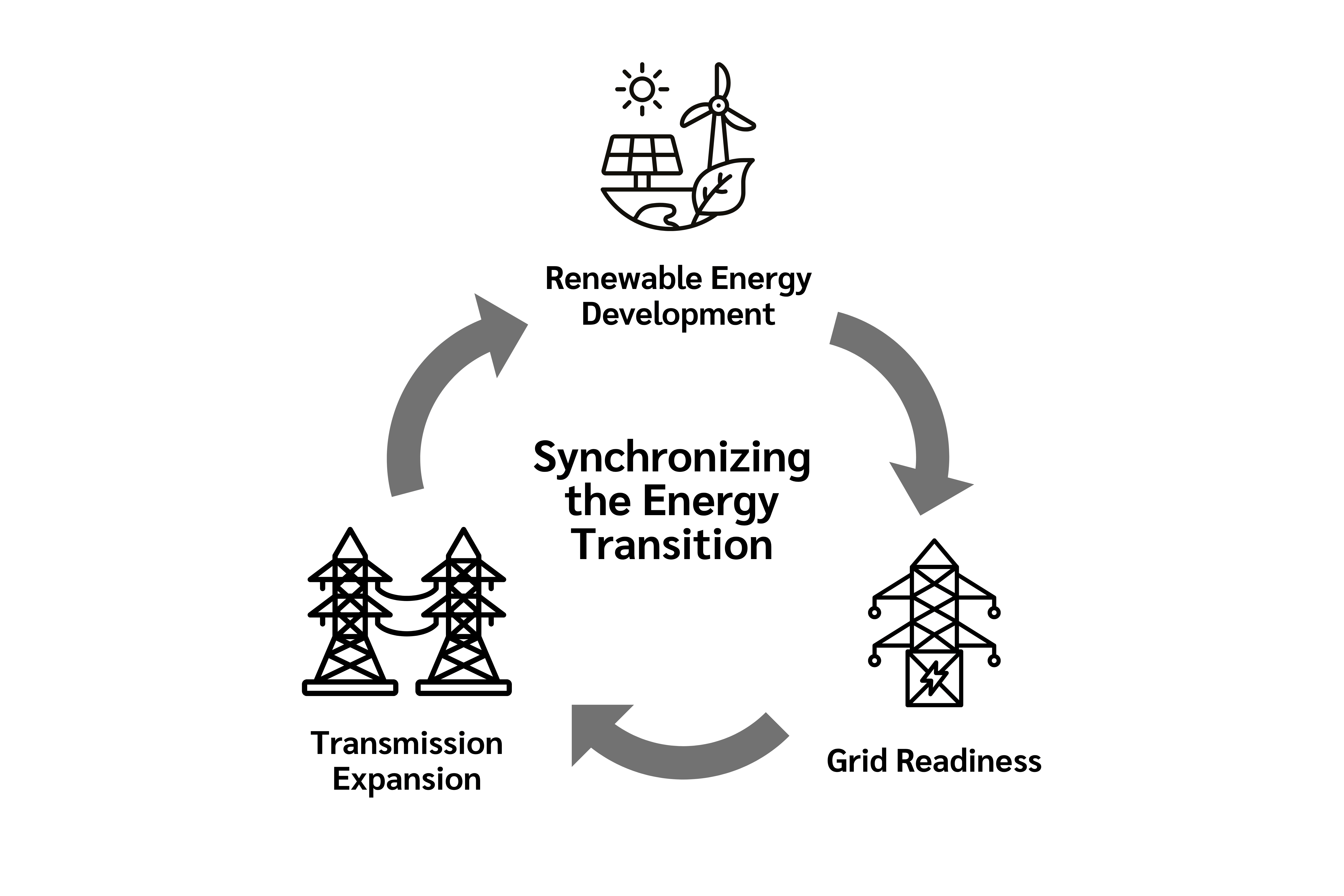
The next stage of the Philippines' energy transition may therefore depend on recognizing transmission readiness as a fundamental input to investment decisions rather than a downstream consideration in project execution.
In renewable energy, construction may mark the beginning of delivery, but it is increasingly no longer the beginning of project risk.
Connect with our specialists to strengthen project certainty from development to operation.